
The lights come up and the last stragglers file out. Someone stacks the chairs, someone else mops the floor, and the venue owner stands in the middle of it all, doing the math in their head.
Did we break even? Can I make payroll? Is the roof going to hold through winter?
The owner stands alone, holding everything.
In 1984, two researchers named David Gumpert and Stephen Boyd published the first scholarly article on entrepreneurship and loneliness. Their finding was staggering: more than 50 percent of small-business owners reported feelings of loneliness. That was four decades ago, before cell phones and social media. Before the gig economy reshaped how we think about work.
The number has not gotten better. A 2025 integrative review of 163 papers across entrepreneurship, leadership, and workplace research found that entrepreneurship remains "a rewarding yet demanding path often marked by loneliness," with significant implications for health and performance.
The music industry has a mental health problem, which is not a controversial statement anymore. Research published in 2025 underscores "the urgent need for an industry-wide code of practice to support mental health and promote sustainable career development," noting that stigma and limited awareness of industry-specific support services continue to keep people quiet.
But here is the part that does not get enough attention: most of the research and resources are aimed at artists and crew. The venue owner is the invisible figure in the ecosystem. They’re working behind the bar, fixing a toilet, answering an email about a noise complaint, and making a decision, alone, about whether to risk booking the act that might not sell but might be the one that changes someone's life.
And owning a venue is nothing like owning a store. You’re not selling a product, you’re selling an experience that is different every night, dependent on the mood of a crowd, the reliability of a sound system, the weather, the local economy, and if the algorithm decided to show your event to anyone.
When it goes wrong, when the act cancels, when the door count is half what you projected, when the city sends a code violation notice two days before a sold-out show, there is no department to escalate to. There is no colleague in the next office to brainstorm with.
That is isolation, and not the poetic kind.
However, as isolated as you may feel, you are not the only one. And the research says so. More than half of the people who do what you do feel the same way.
The industry is starting to wake up. Nonprofits like Backline are connecting music professionals with mental health resources. The comprehensive manual "Touring and Mental Health: The Music Industry Manual," edited by psychotherapist Tamsin Embleton, is providing real, industry-specific guidance for the first time.
But this is still mostly aimed at the people on stages. The person whose name is on the lease, the one who has not taken a real vacation in three years, is still standing alone in the most crowded room in town.
That is the person we need to talk about next. So let’s talk.
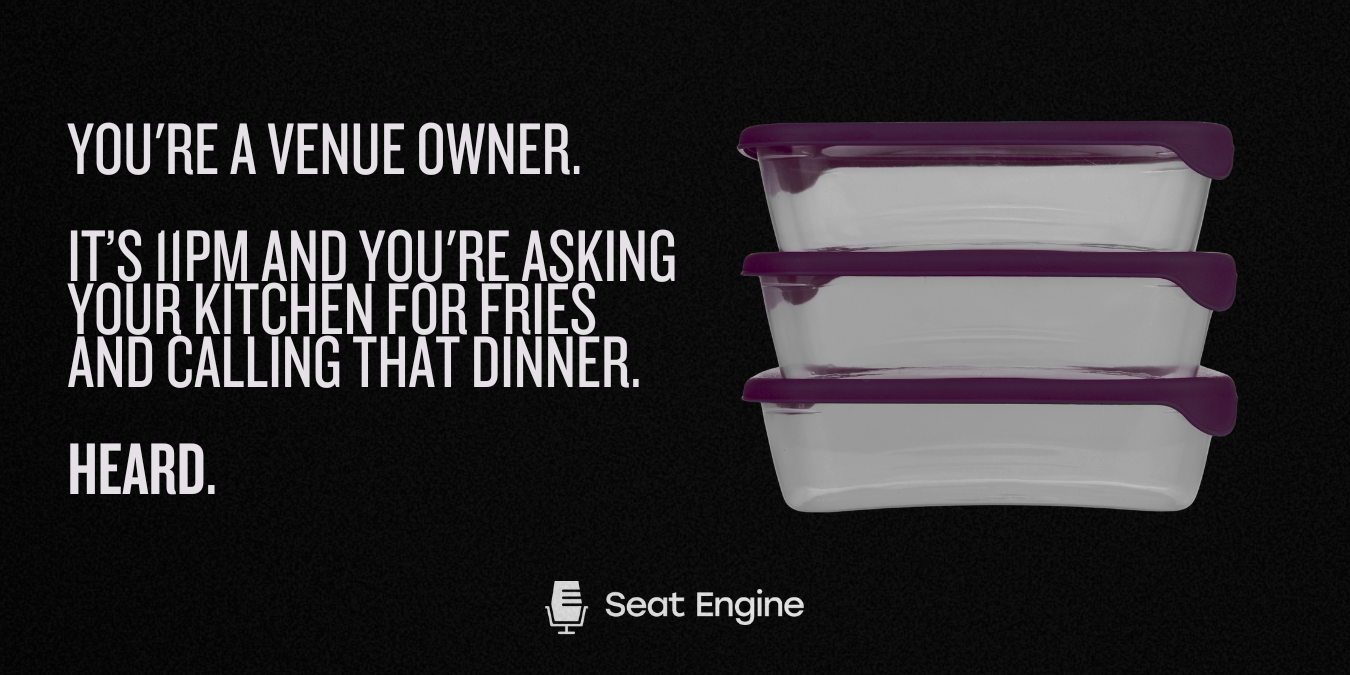
We’re getting 15 venue owners together to connect with one another, and to learn how to meal-prep for the life they actually live. The kitchen staff you ask for fries from every night at 11pm? They’re about to be stunned by your quinoa salad.
Spaces are limited. We'll get in touch if we have space for you. Thank you for your interest!
Sources
Skiddle Mental Health Survey, promotioncentre.co.uk (2018, referenced 2025)
Understanding entrepreneurs' loneliness: An integrative review of 163 papers," tandfonline.com (2025)
Cardon et al., "The many faces of entrepreneurial loneliness," onlinelibrary.wiley.com (2024)
"Exploring the Mental Health Challenges of Music Industry Professionals," journals.sagepub.com (2025)
Neon Music, "More Than a Headlining Act: Mental Health Support Becomes a Staple of the Music Business," neonmusic.co.uk (October 2025)